
The short answer
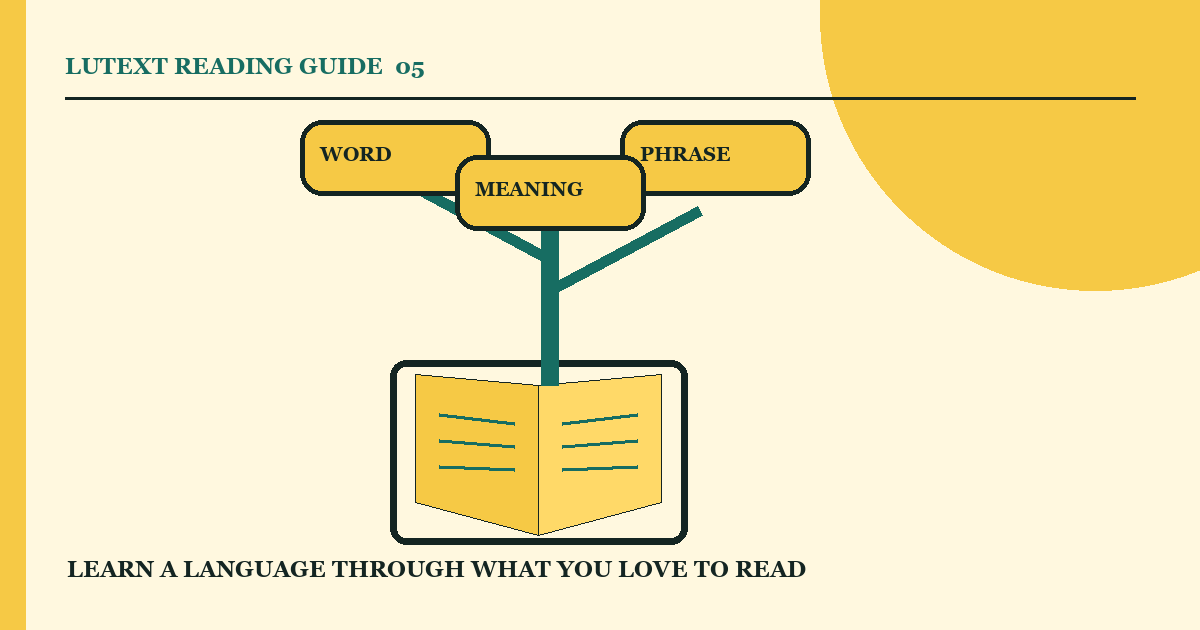
Reading builds vocabulary well because words arrive inside situations, return in varied forms, and join a network of meaning instead of a flat list.
Reading grows vocabulary through context, repetition, and meaningful connections. Learn how that process works and how to make it more reliable. This guide gives you clear steps, real examples, and a simple plan you can test with your next book.
A word is more than its translation
Knowing vocabulary includes meaning, spelling, grammar, register, typical partners, and the situations in which a word feels natural. A bilingual pair supplies an entry point but not the whole knowledge. Texts reveal these layers gradually.
The English word ‘issue’ can be a problem, a topic, an edition, or an act of distribution. Several real sentences teach boundaries that a single equivalent hides.
Try this: When saving a word, keep its sentence and note what job it performs there.
Context creates memory hooks
Narrative gives a new word people, motives, images, and consequences. These associations create multiple routes back to meaning. Emotional or surprising scenes are especially memorable because attention was already high.
A word for ‘whisper’ encountered during a secret conversation is easier to retrieve than the same item in an alphabetical list. The scene supplies sound, intention, and contrast with ordinary speech.
Try this: After a useful lookup, picture the exact moment in the text before continuing.
Repetition changes the quality of knowledge
The first encounter may produce only recognition. Later encounters clarify form, collocations, and range. Research on repeated exposure shows that different aspects of word knowledge strengthen at different rates; one meeting rarely completes the job.
A learner first guesses a verb from action, later sees it with a new object, then notices its past form. The word becomes flexible through variation.
Try this: Prioritize words that recur in the book. The author is already scheduling natural review.
Reading teaches families and partnerships
Words cluster. A noun attracts particular verbs and adjectives; a root appears in several forms; a connector repeatedly organizes the same relationship. Reading exposes these partnerships at a scale flashcards struggle to imitate.
Instead of learning ‘decision’ alone, the reader meets ‘make a decision,’ ‘reverse a decision,’ and ‘a difficult decision.’ Those combinations are what fluent production later needs.
Try this: Save a short phrase rather than a naked word when the phrase is the natural unit.
Inference is useful even when imperfect
Trying to infer meaning forces attention to syntax and situation. Checking afterward checks that inference. The productive sequence is guess, verify when necessary, and return to the sentence—not either guessing everything or translating everything.
If a character grabs an umbrella and the verb is unknown, weather and movement constrain the possibilities. Morphology may provide another clue.
Try this: State a rough guess in a few words before tapping the translation. Compare, correct, and move on.
Not every new word deserves study
Low-frequency decorative terms can consume review time without improving everyday understanding. Selection should reflect recurrence, usefulness, personal relevance, and the word's role in understanding the text.
A historical novel may contain precise carriage parts. Enjoy the detail, but save the verbs and connectors that will travel into other books.
Try this: Use a small daily saving limit. Scarcity forces useful judgement and keeps review humane.
Review works best when it returns to meaning
Spaced review supports recall, but cards become stronger when they retain a sentence and ask for understanding rather than exact translation alone. Reopening the original passage adds narrative context.
A card for a French connector can show the sentence with the connector hidden, then ask which relationship—contrast, cause, or sequence—fits.
Try this: Mix brief scheduled review with continued reading. New chapters are unscripted tests of old vocabulary.
Vocabulary growth is cumulative and uneven
Readers often acquire partial knowledge without noticing. Many words become familiar before they become definable or usable. This is normal. A large vocabulary is built through thousands of small, incomplete advances.
You may recognize a word instantly in the same genre and hesitate elsewhere. Broader reading later makes that knowledge useful in new places.
Try this: Judge vocabulary growth over months through easier understanding and fewer essential lookups, not by demanding perfect recall after every chapter.
A practical plan for the next seven days
Pick one idea from this guide and try it for seven days. Use the same book and roughly the same reading time. This makes it easier to see whether the change helps.
At the end of the week, ask three questions: Did I understand more? Did I stop less often? Did I want to keep reading? Keep what worked. Change one thing that did not.
References
- Paul Nation, How Large a Vocabulary Is Needed for Reading and Listening?, The Canadian Modern Language Review, 2006.
- Hitoshi Nakanishi, A Meta-Analysis of Extensive Reading Research, TESOL Quarterly, 2015.
- Eun Hee Jeon and Richard R. Day, The Effectiveness of Extensive Reading on Reading Proficiency: A Meta-Analysis, Reading in a Foreign Language, 2016.
- Stuart Webb, The Effects of Repetition on Vocabulary Knowledge, Applied Linguistics, 2007.
- Ana Pellicer-Sánchez and Norbert Schmitt, Incidental Vocabulary Acquisition from an Authentic Novel, Reading in a Foreign Language, 2010.
- The Extensive Reading Foundation, Guide to Extensive Reading, practical guidance for teachers and independent learners.
- Council of Europe, Common European Framework of Reference for Languages: Companion Volume, 2020.